How to Paint a Hallway — Ireland's Trickiest Room Done Right
Hallways are narrow, awkward, high-traffic, and often poorly lit. A professional painter in Carrickmacross explains how to approach Ireland's most challenging decorating job.
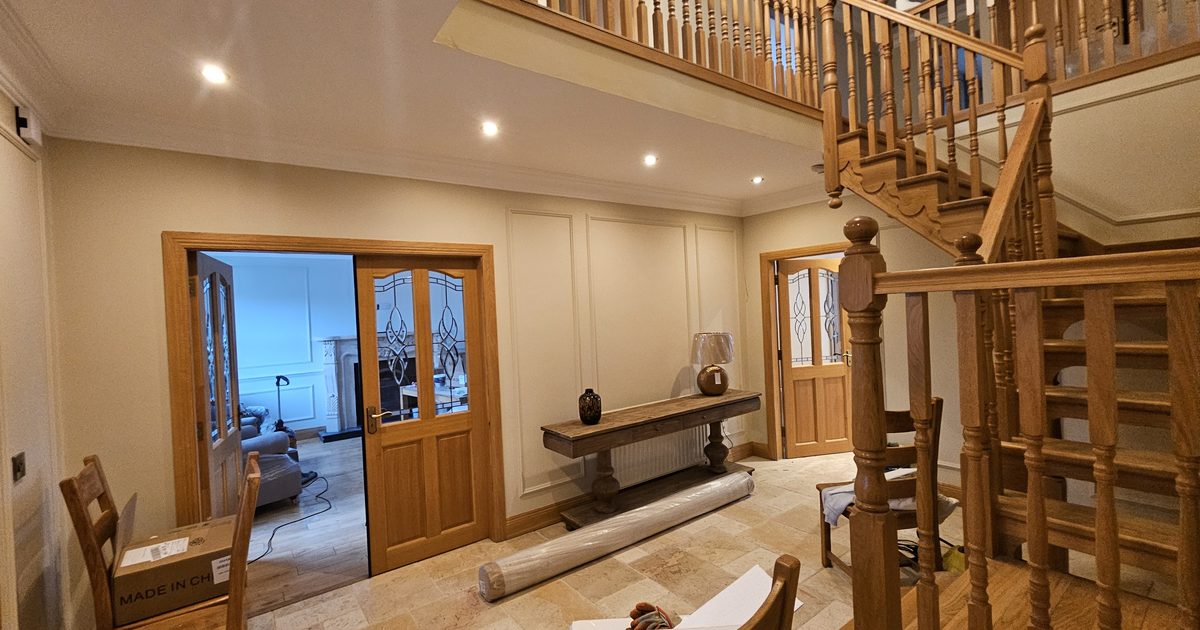
The hallway is widely regarded among professional painters as the most demanding interior decorating job in a typical Irish home. It’s narrow, it has stairs, it has multiple doors and frames to cut around, it’s high-traffic and prone to marks, and it often has a stairwell that requires working at height in a confined space. Get it right and it sets the tone for the entire house. Get it wrong and it’s the first thing every visitor sees.
As a professional interior painter serving Carrickmacross and Co. Monaghan, here’s how to approach the hallway properly.
Why Hallways Are Difficult
Access. Standard hallways in Irish semi-detached houses are 900mm-1000mm wide. Working in this space with a roller, a ladder, dust sheets, and paint trays is physically awkward. The stairwell adds height and angle challenges that don’t exist elsewhere in the house.
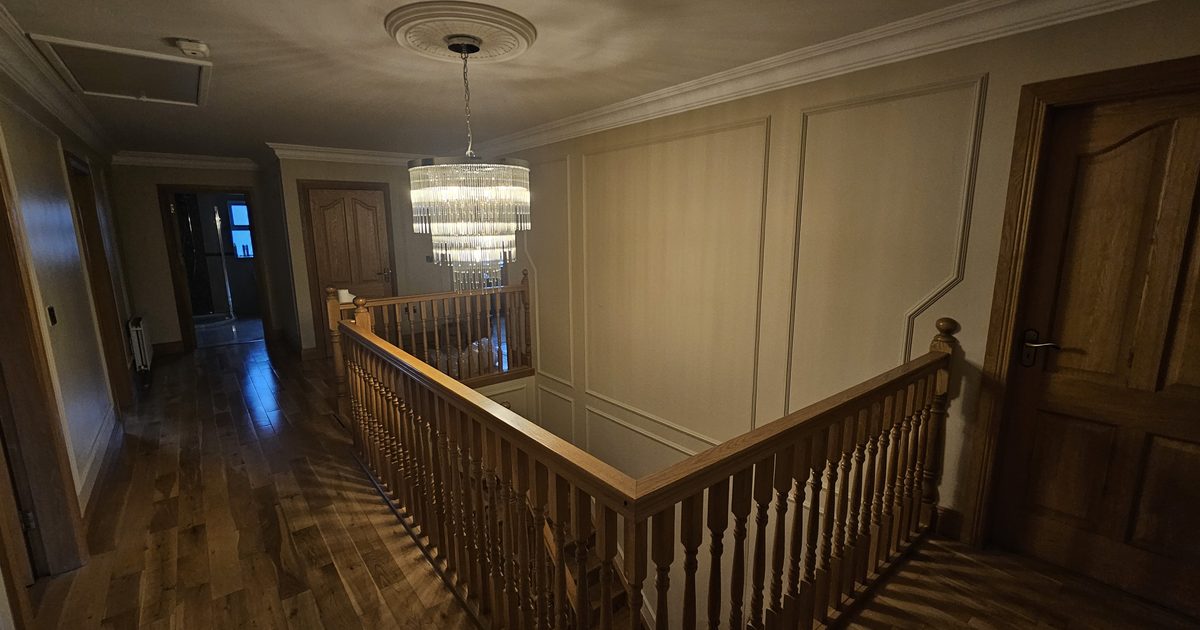
The stairwell. Painting the stairwell — the wall that runs alongside the stairs and up through one or two storeys — requires working at height with changing floor levels. This typically means a combination of stepladder, platform, or specialist staircase ladder arrangement. It’s the single most dangerous painting task in a domestic property. Never improvise access — a proper setup is essential.
High traffic and durability demands. The hallway takes more daily use than any other room in the house. Coats being dragged along walls, bags bumping against surfaces, dogs, children, visitors — the hallway paintwork takes constant abuse. This makes finish choice more important here than anywhere else.
Multiple surfaces and transitions. A typical Irish hallway has wall surfaces, a ceiling, coving or a coving-ceiling junction, a stair soffit (the sloped underside of the stairs), skirtings, architraves around multiple door frames, banister, spindles, handrail, newel post, and often a front door. Each has its own product and technique requirements.
The Right Paint Finish for Hallways
This is where hallway painting is most commonly got wrong. Flat or dead matt paint — however beautiful it looks in a bedroom or living room — is not appropriate for a hallway. It marks easily, it scuffs, and it cannot be cleaned without burnishing.
Walls: Soft sheen, silk, or a washable mid-sheen emulsion. Something that can be wiped down regularly. Dulux Easycare, Crown Breatheasy Matt (which has slightly better washability than flat matt), or similar. If the walls are rough or uneven, a lower sheen is more forgiving — if they’re smooth and well-prepared, a slightly higher sheen is more practical.
Woodwork: Eggshell or satin. The hallway skirtings, architraves, and door frames need to be hardwearing. Water-based satin from Dulux Trade or Crown Trade gives a contemporary finish that’s far more durable than standard matt paint on woodwork.
Banister and handrail: These are handled constantly. Use a durable satin or eggshell, applied over a properly prepared and primed surface. Oil-based products have traditionally been preferred here for their hardness, but modern water-based satins are now robust enough for most domestic applications.
Spindles: Thin, fiddly, and numerous. Small brush, careful application, watch for drips. Many spindles have deep grooves or profiles that need paint worked in carefully rather than just applied to the face.
Front door: A full subject in itself — but briefly: exterior gloss or satin on the outside face, interior eggshell or satin on the inside face. Make sure the product is appropriate for the face it’s going on.
Colour Choices for Irish Hallways
The conventional advice is to go light in a hallway — to maximise what natural light there is and avoid making a narrow space feel even narrower. This is sound advice for very dark or very narrow hallways.
However, as we explore in our guide on light colours vs dark colours, dark hallways can work extremely well. In a hallway where daylight is limited anyway, a deep, rich colour — navy, forest green, warm charcoal — can create a dramatic, welcoming entrance that tells visitors immediately this is a house where someone thought about the decoration.
The key is ensuring the rest of the space — ceiling colour, woodwork colour, the light fitting — works with the wall colour to prevent the space from feeling oppressive.
Practical Tips for the Stairwell
Work methodically from the top of the stairwell down. Paint the ceiling area of the stairwell first, then work down the sloped wall that follows the stairs, then the lower landing walls.
For access on a standard two-storey Irish staircase, a combination of a stepladder at the bottom of the stairs and a standard ladder resting on the stairs themselves (with ladder stay or standoff to protect the wall) is commonly used. Hire a proper staircase multi-position ladder if you’re doing this yourself — the few euro of hire cost is well spent against the risk of an improvised setup.
Have a second person present whenever you’re working at height in a stairwell. This is not optional.
The Finish That Lasts
With the right finish, a well-painted hallway in a Co. Monaghan home should look good for 5-7 years despite the traffic. With the wrong finish, it can look marked and tired within 18 months.
The difference is the product choice and the preparation — the same principles covered in our guide on the hidden prep work that makes a professional finish apply here at least as strongly as anywhere else in the house.
For our full interior painting service across Carrickmacross and Co. Monaghan, including hallways and stairwells, visit our interior painting service page.
Need a hallway or stairwell painted properly in Carrickmacross or Co. Monaghan? Call or WhatsApp Mark today: 0879197709. Free quotes, safe working practices.
Need professional interior painting services in Carrickmacross?