The Hidden Prep Work That Makes a Professional Finish
The difference between a professional paint finish and an amateur one is almost never the paint itself. A decorator in Carrickmacross reveals the preparation work that nobody sees — but everyone notices.
People who hire professional painters often comment, after the job is done, that the results look somehow different to what they achieve themselves — even when they use the same paint. The colour is the same. The roller technique looks similar. So why does it look better?
Almost always, the answer is in the preparation that happened before the paint was opened.
As a professional decorator working across Carrickmacross and Co. Monaghan, here’s the work that clients rarely see but always benefit from.
The Patience Test: Filling Every Imperfection
Walk a room before painting and really look at the walls in raking light — a torch or work light held at a low angle and moved across the surface. You’ll see imperfections that are completely invisible under normal overhead lighting: small holes from picture hooks, hairline cracks around door frames, slight ridges where previous filler has been applied at slightly the wrong angle, minor dents from furniture, screw holes that were painted over years ago and have now sunk.
All of these get filled before any paint goes on.
A professional does not assess which holes are “too small to matter.” They all get filled. The reason: once paint goes on — especially a finish with any sheen — these small imperfections are illuminated rather than hidden. A 3mm hole becomes a visible dark shadow. A hairline crack becomes a feature rather than a detail.
Filling properly means using the right filler for the job (fine surface filler for small imperfections, a harder two-part filler for deeper damage), applying it slightly proud of the wall, letting it dry fully, and sanding it perfectly flush. The sanding is as important as the filling — a poorly feathered repair has a slight dome that shows through the paint as a raised area.
The Surface Wash That Gets Skipped
Walls accumulate a film of dust, grease, and residue over years of occupation. In kitchens it’s cooking grease. In living rooms it’s general household dust and residue from open fires. In hallways it’s contact marks around light switches and door handles.
Paint applied to a contaminated surface bonds poorly. The contamination acts as a barrier between the paint and the wall, leading to adhesion problems that manifest as peeling or flaking — sometimes immediately, sometimes months later.
Every room gets washed down with sugar soap solution before a professional begins. This is not a cursory wipe — it’s a methodical wash, working from top to bottom, covering all surfaces. The walls then need to dry fully before paint goes on.
Most DIY painters skip this stage entirely. Most professional painters would not consider skipping it.
Sanding Between Coats
After the first coat of paint has dried fully, a professional will sand lightly before the second coat. This step serves two purposes:
First, it removes any dust nibs or small bits of dried paint that have created bumps in the surface. These are almost inevitable — even in a clean room, there’s airborne dust. A light sand with fine grit paper removes them before they become visible features in the final finish.
Second, it gives the second coat a fresh key to grip. Sanding between coats improves adhesion and gives the final surface a more consistent, smooth appearance.
This step adds time. On a full house repaint, sanding between coats across every surface adds several hours to the job. Professional painters do it anyway because the result justifies it.
The Caulk That Seals the Gaps
Look closely at the joints between woodwork and walls in most rooms — where skirtings meet plaster, where door frames meet adjacent walls, where coving meets walls and ceilings. In most properties there are small gaps at these joints that have been filled and cracked multiple times over the years as the building moves and settles.
Paint bridges these gaps temporarily, but as the building continues to flex, the paint cracks and the gaps reappear. The professional solution is to fill these joints with decorator’s flexible caulk rather than rigid filler. Caulk moves with the building and doesn’t crack.
Applying caulk to all the woodwork-to-wall joints before painting, allowing it to cure, and painting over it gives a crisp, finished line that holds for years rather than cracking within a season.
Masking and Protection
Cutting in freehand — painting edge lines against ceilings, coving, and woodwork without tape — is a skill that takes years to develop. A professional painter with a good brush and a steady hand can cut in faster and cleaner than tape allows.
Where tape is used, it’s applied carefully to the correct surface, pressed down firmly at the edge, and removed at exactly the right time — while the paint is still slightly tacky but not wet. Tape left too long tears the paint film off the surface when removed.
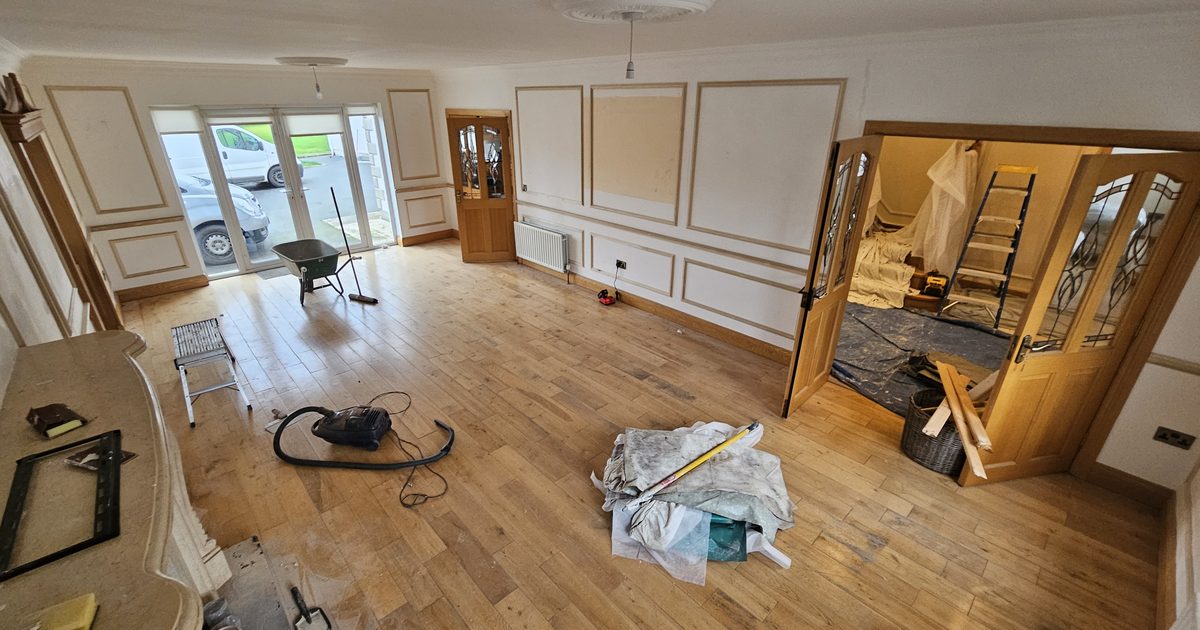
The floor protection is laid without gaps, and dust sheets are checked and repositioned rather than left where they were kicked to during the preparation work.
Why This Matters
None of the preparation described above shows in the finished result — at least, not directly. What shows is its absence. When preparation is skipped, the imperfections it would have addressed show through every coat of paint.
This is the core difference between a professional result and a rushed DIY job, and it’s why the cheapest quote is rarely the best value. A painter who prices for doing all of this properly takes longer and charges accordingly — but delivers a result that looks better immediately and holds up significantly longer.
For more on achieving a professional finish, read our guide on how to get a flawless paint finish and on the right order to decorate a room from start to finish.
For the full decoration service across Carrickmacross and Co. Monaghan, visit our full finish and decoration service page.
Want decoration done properly in Carrickmacross or Co. Monaghan — preparation included? Call or WhatsApp Mark today: 0879197709. Free quotes.
Need professional full finish & decoration services in Carrickmacross?