How Often Should You Paint the Outside of Your House in Ireland?
Ireland's climate is tough on exterior paint. A professional exterior painter in Carrickmacross explains how often you should repaint and what affects the lifespan of your exterior finish.
Ireland’s weather is one of the most challenging environments for exterior paint in Europe. High rainfall, persistent humidity, Atlantic winds, and the regular cycle of wet and dry conditions all take a toll on masonry and woodwork faster than most homeowners realise. So how often do you actually need to repaint the outside of your house?
As a professional exterior painter serving Carrickmacross and across Co. Monaghan, here’s the realistic picture.
The General Rule: Every 5-10 Years
For most houses in Ireland, exterior masonry painting needs to be done every 5-10 years. That’s a wide range — and the difference between five years and ten depends on several factors we’ll go through below.
Exterior woodwork — fascias, soffits, window frames, and doors — typically needs attention more frequently, every 3-7 years, because wood responds more dramatically to moisture and temperature changes than painted masonry.
What Makes Paint Fail Faster
Aspect and exposure. A south or west-facing wall takes the full force of Irish weather — driving rain, UV from what sun we do get, and drying winds. These walls typically deteriorate 30-40% faster than north or east-facing ones on the same house. It’s common for one side of a Monaghan house to need repainting well before the others.
Surface preparation on the previous job. This is the single biggest factor in how long a paint job lasts. Exterior paint applied over a properly cleaned, primed, and prepared surface can last a decade. Paint applied over dirty, chalky, or poorly prepared masonry may start to fail within 2-3 years. This is why preparation is never a corner worth cutting — read more in our guide to how to prepare exterior walls before painting.
Quality of paint used. A premium masonry paint like Dulux Weathershield or Sandtex contains more binders and UV inhibitors than a budget paint. It genuinely lasts longer. Cheap exterior paint is a false economy — you end up repainting sooner and spending more overall.
Porosity of the substrate. Old, porous masonry absorbs paint unevenly and gives it less to grip. Very smooth, dense surfaces like engineering brick hold paint better than rough, open-textured render.
Moisture issues. Paint applied over damp walls — or walls that develop damp after painting — will fail prematurely regardless of quality. Bubbling, flaking, and peeling on exterior walls is almost always a moisture problem at its root. Read our guide on how to deal with damp and mould before painting exterior walls if this is a concern.
Climate exposure. Properties in exposed rural locations in Monaghan — particularly anything elevated or near open farmland — tend to have exterior paint fail faster than sheltered suburban properties. Wind-driven rain is relentless on exposed gable walls.
Signs You’re Due a Repaint
You don’t necessarily need to wait for obvious failure. These are the indicators that your exterior is approaching the end of its useful painted life:
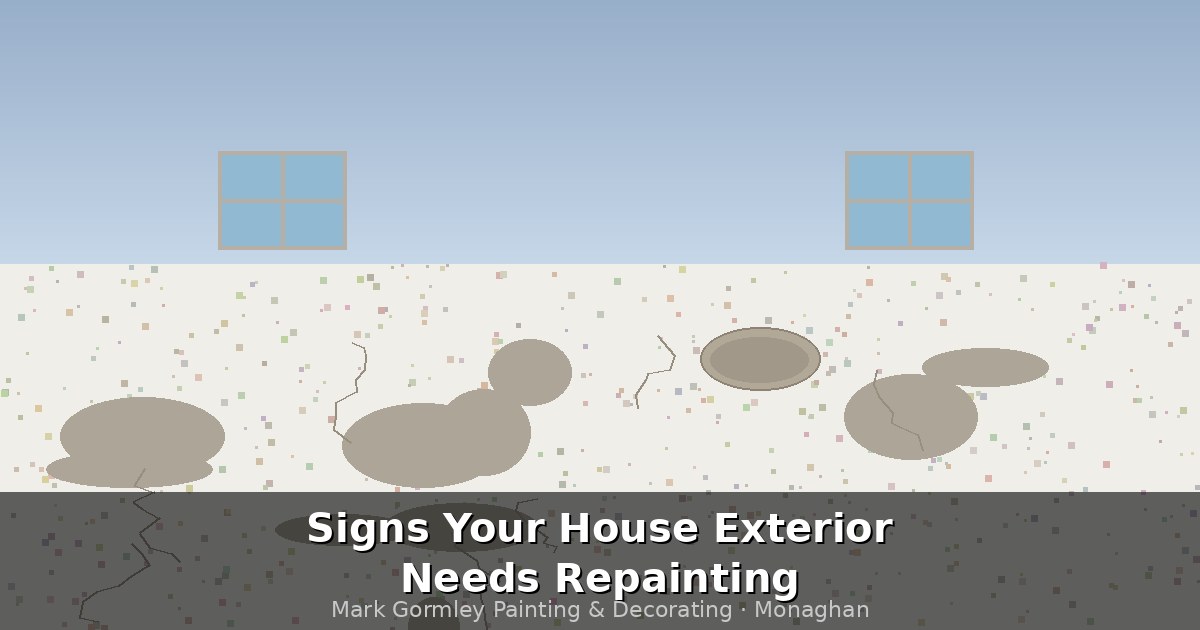
- Chalking — a powdery residue when you rub the surface. The paint binder has degraded and the pigment is coming away.
- Fading — the colour has significantly lightened or changed tone
- Cracking — fine surface cracks that haven’t yet progressed to the masonry beneath
- Peeling or flaking — the paint film is separating from the surface
- Algae or moss growth — green or black biological growth on the surface
For a detailed breakdown of what to look for, see our post on signs your house exterior needs repainting.
The Cost of Leaving It Too Long
Waiting until the paint has completely failed costs more to fix than repainting at the right time. When paint degrades to the point of significant peeling and the masonry is exposed, the preparation required before repainting is substantially more intensive — pressure washing, extensive scraping, possible application of stabilising primer, and more coats to rebuild the paint system.
A timely repaint every 7-8 years on well-maintained masonry is significantly cheaper overall than leaving it 12-15 years and having to carry out remedial work first.
Practical Advice for Monaghan Homeowners
Given Co. Monaghan’s climate — reliable rainfall, regular humidity, and exposure to Atlantic weather — I’d recommend:
- Masonry walls: Plan for repainting every 7-8 years as a baseline
- Exposed gables and west/south-facing walls: Check every 5 years and repaint earlier if needed
- Woodwork (fascias, soffits, windows, doors): Inspect every 2-3 years and repaint every 4-6 years
- New builds: First exterior repaint typically around 5-7 years after the original decoration
The best time to paint is late spring to early autumn — dry spells above 10°C. Read our guide on the best time of year to paint the outside of your house in Ireland for more on timing.
Getting the Most From Your Exterior Paint Job
The key to maximising the interval between repaints is the quality of the job done each time. Proper preparation, quality paint, and correct application by an experienced exterior painter in Co. Monaghan will give you 8-10 years of solid performance. See our full exterior painting service page for more on what that process looks like.
Need an exterior painter in Carrickmacross or Co. Monaghan? Call or WhatsApp Mark today for a free quote: 0879197709.
Need professional exterior painting services in Carrickmacross?