Signs Your House Exterior Needs Repainting Right Now
Not sure if your house exterior needs a repaint or if it can wait? A professional exterior painter in Carrickmacross lists the warning signs homeowners should never ignore.
Most homeowners don’t think about exterior repainting until it’s already overdue. The problem with that approach is that leaving an exterior paint job too long doesn’t just mean a worse-looking house — it means more preparation work, more remedial repairs, and a higher overall cost when you do eventually get around to it.
As a professional exterior painter serving Carrickmacross and across Co. Monaghan, here are the signs that tell me a house exterior needs attention — some obvious, some less so.
1. The Paint Is Chalking
Run your hand along an exterior wall. If it comes away with a white or coloured powdery residue, the paint is chalking. This is one of the most reliable indicators that a masonry paint is approaching the end of its useful life.
Chalking happens when the binder in the paint — the ingredient that holds everything together and keeps it adhered to the wall — has degraded due to UV exposure and weathering. The pigment is essentially loose on the surface.
At this stage, the wall needs a stabilising primer before any new paint is applied. Painting directly over chalky masonry without stabilising it means the new paint has nothing solid to bond to and will fail quickly.
2. Paint Is Visibly Peeling or Flaking
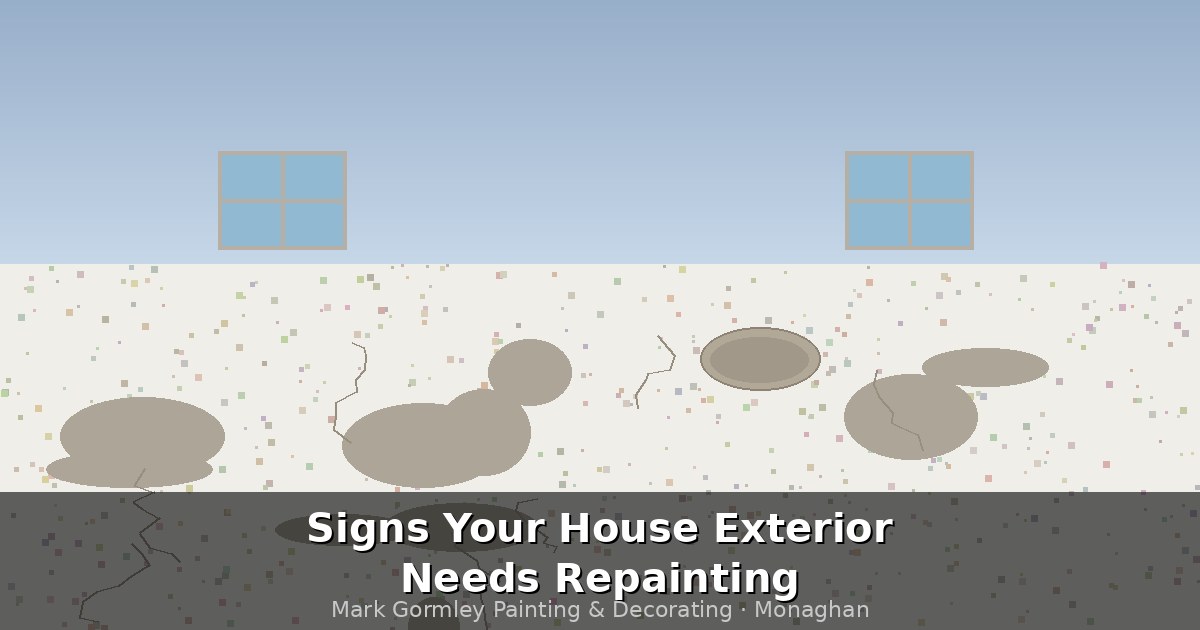
This is the most obvious sign and the one most homeowners recognise. When paint begins lifting away from the surface in sheets or flakes, it has lost adhesion to the substrate beneath.
The causes vary: moisture trapped in the wall, poor preparation on the previous paint job, painting over incompatible products, or natural deterioration over time. But the result is the same — the paint is no longer doing its job of protecting the masonry beneath.
The longer this is left, the more preparation will be required when you eventually repaint. Each peeling area needs to be fully stripped back to a sound surface before new paint can be applied.
3. Visible Cracking in the Paint Film
Fine hairline cracks in exterior paint are normal in older paint films. Wide, deep cracks — particularly ones that follow the shape of the render or masonry beneath — indicate something more serious.
Cracks allow water in. In Ireland’s climate, water ingress into masonry leads to freeze-thaw damage in winter, mould growth, and potentially damp issues inside the property. Cracks that reach down to bare render or expose joints need to be addressed urgently, not just painted over.
4. Algae, Moss, or Lichen Growth
Green or black biological growth on exterior walls is extremely common in Co. Monaghan and throughout Ireland — our damp climate is ideal for it. A small amount of surface algae isn’t an immediate emergency, but significant biological growth indicates:
- The existing paint’s biocide has been exhausted
- The surface is retaining moisture
- Without treatment, the growth will continue to hold moisture against the wall
Before repainting, biological growth must be treated with a fungicidal or biocidal wash and fully removed — not just painted over. See our guide on how to prepare exterior walls before painting for the full process.
5. Significant Colour Fading
Exterior paint fades over time, particularly on south and west-facing walls that receive the most UV exposure. Some fading is expected and normal — but when the colour has changed significantly or looks noticeably uneven across different walls, it’s a cosmetic sign that the paint film is nearing the end of its protective life as well.
South and west-facing walls on Monaghan homes often fade noticeably faster than north-facing walls on the same house.
6. Damp Patches or Staining on the Interior Wall
This is the most urgent sign of all. If you’re noticing damp patches on interior walls — particularly on external-facing walls — the exterior paint may have failed as a weather barrier.
While there can be other causes of damp, failed exterior paint is a common one. If you see moisture penetration inside, the exterior should be inspected as a priority alongside checking gutters, flashings, and pointing.
7. Staining Around Gutters and Downpipes
Dark streaking or staining on exterior walls below gutters and around downpipes usually indicates a leaking gutter or a blocked downpipe. Left unaddressed, this constant moisture contact will cause the paint in those areas to fail faster than the rest of the wall.
Fix the gutter first, then repaint — not the other way around.
8. The Woodwork Is Looking Tired
Exterior woodwork — fascias, soffits, window frames, and the front door — often deteriorates before the masonry because timber is more responsive to moisture and temperature changes. If these elements are looking faded, cracked, or peeling, the whole exterior is starting to look run-down even if the masonry is still holding.
Read our guide on painting fascias and soffits for more on addressing these elements specifically.
The Cost of Waiting
Every year you defer an exterior repaint that’s already overdue means more preparation time and cost when the job is eventually done. Chalking walls need stabilising. Peeling areas need fully stripping. Cracked render needs repairing. All of this adds cost — more so than a timely repaint on a surface that’s still in reasonable condition.
For more on when exterior repainting makes sense and how to plan it, see our full exterior painting service page covering Carrickmacross and Co. Monaghan.
Is your house exterior showing any of these signs in Carrickmacross or Co. Monaghan? Call or WhatsApp Mark for a free assessment and quote: 0879197709.
Need professional exterior painting services in Carrickmacross?